
💡 The Best of Both Worlds: Softness Meets Strength
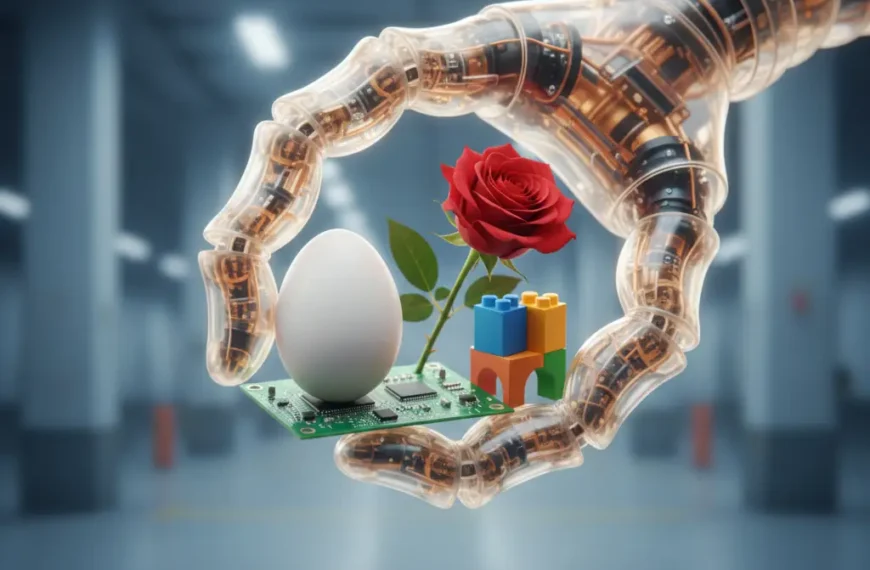
Soft robots excel at delicate handling and navigating unstructured environments, thanks to their flexible, compliant nature. However, a purely soft machine struggles with tasks requiring high force, stability, or precision—like holding a heavy wrench or pushing a lever.
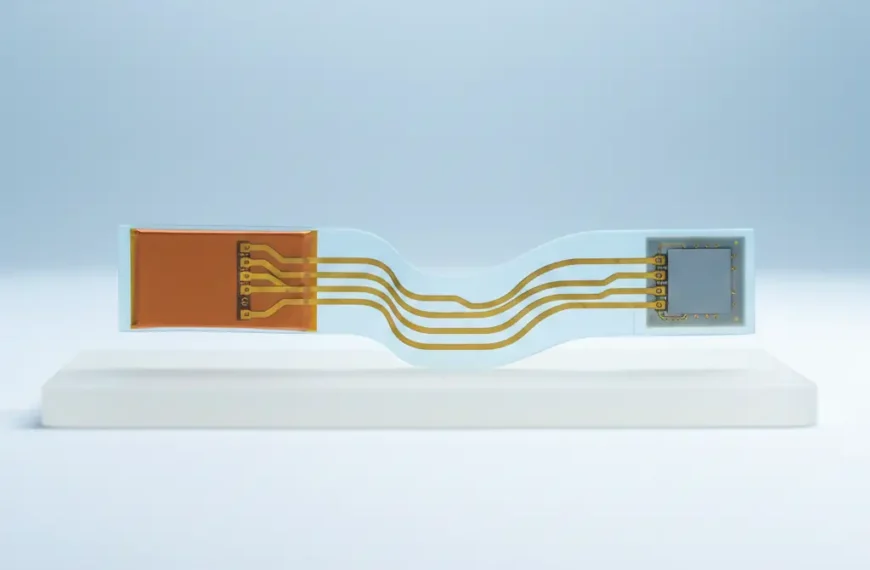
The solution lies in a truly game-changing technology: Programmable Stiffness. This allows a robot to instantly transition from a safe, adaptable, soft state to a rigid, strong, load-bearing state, all within the same structure.
It’s about achieving the maneuverability of an octopus and the load capacity of a rigid industrial arm, giving these compliant machines the best capabilities of both worlds.
—
🔬 The Science of Switching: Methods for Variable Stiffness
Achieving on-demand stiffness requires clever material science and actuation methods. Researchers have developed several core techniques to control a material’s rigidity, effectively ‘locking’ the robot into a desired shape.
1. Granular Jamming: The Coffee Bag Principle
One of the most effective and widely used methods is Granular Jamming. Think about a sealed bag of ground coffee: when you first pick it up, it’s soft and shapeless. But if you suck all the air out, the bag instantly becomes stiff and rigid.
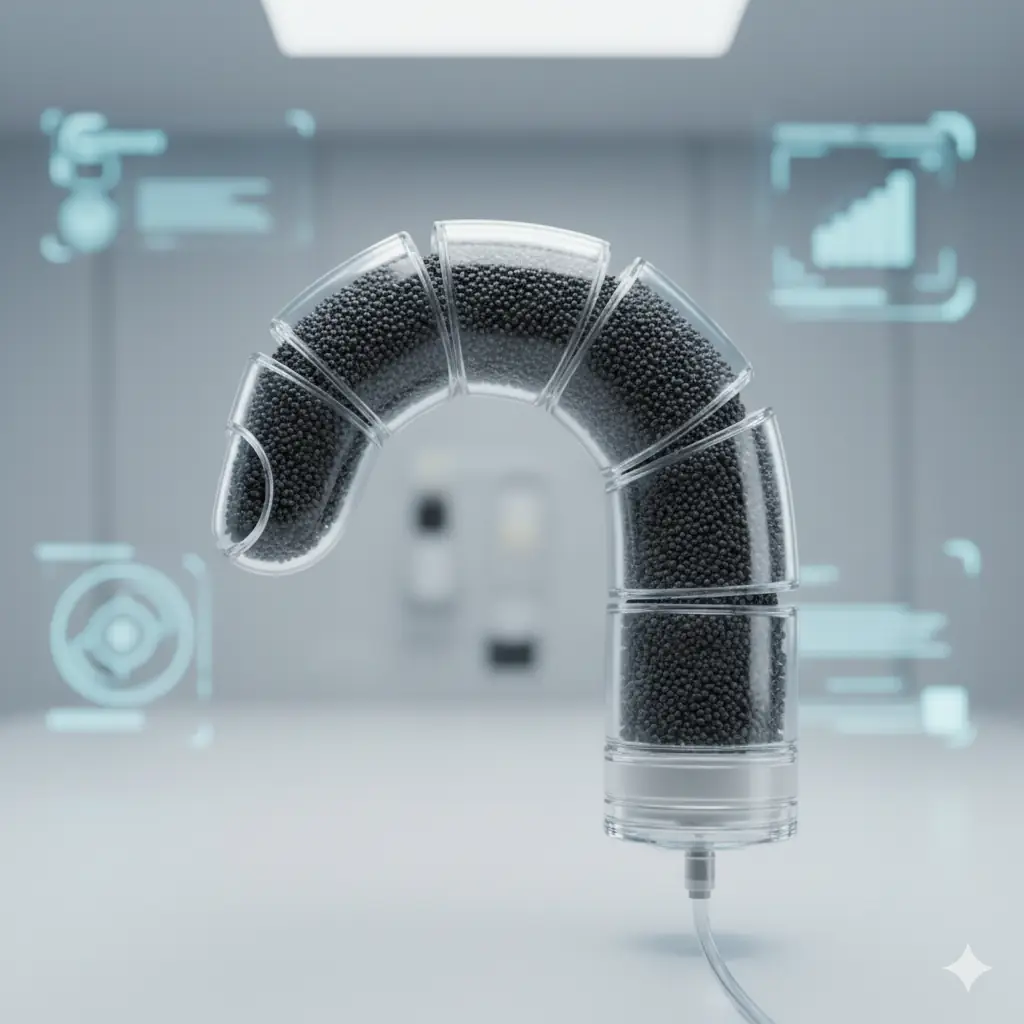
Roboticists apply this by filling soft polymer chambers with tiny particles, like coffee grounds, sand, or plastic beads. When a vacuum is applied, the pressure forces the particles together, increasing the friction between them and effectively ‘jamming’ the structure into a solid state.
This method is rapid, reversible, and provides a high degree of stiffness change. A soft gripper can wrap around an object while compliant, then jam to achieve a firm grip for lifting.
2. Layer Jamming: Thin Sheets Doing Heavy Lifting
Similar to granular jamming is Layer Jamming or foil jamming. Here, multiple thin, flexible sheets or foils are stacked together inside a soft casing. When air is evacuated, the friction between the layers dramatically increases.
This allows the structure to lock into place, offering an alternative mechanism for stiffening long, thin structures like robotic arms or surgical tools where granular materials might not be suitable.
3. Phase Change Materials: Heat and Hold
Other methods utilize materials whose properties change with temperature, known as Phase Change Materials. These substances are liquids or very soft solids at room temperature but solidify when cooled or heated.
For example, a robot could be filled with a low-melting-point wax. Once the soft robot takes the desired shape, the wax is cooled to solidify, locking the shape instantly. While less rapid than jamming, it offers superior load-bearing strength.
—
🛠️ Why Programmed Stiffness is Necessary
The need for programmable stiffness arises in any task where the robot must transition between adaptive interaction and forceful manipulation. This combined capability dramatically expands the operational scope of soft robots.
Handling and Locomotion Synergy
Consider a soft robot designed for exploration in rough terrain. It needs to be flexible to absorb impacts and navigate uneven ground—the soft phase. But if it needs to lift itself over an obstacle or pry open a door, it must stiffen its body to create leverage and apply force—the rigid phase.
This capability is also crucial for stability during movement. An extremely soft robot might be prone to uncontrolled oscillations or shaking when moving quickly. Instant stiffening allows the robot to dampen vibrations and move with precision.
Micro-Case Example: A soft robotic snake designed to move through collapsed pipes uses its flexibility to weave through debris. Upon locating a load-bearing wall, it jams a section of its body to become a rigid probe, pushing against the debris to create an opening.
—
🚀 Applications Across Industries
The ability to switch stiffness opens up new possibilities in medicine, manufacturing, and exploration, making soft robotics relevant in high-stakes, real-world environments.
Medical and Surgical Tools
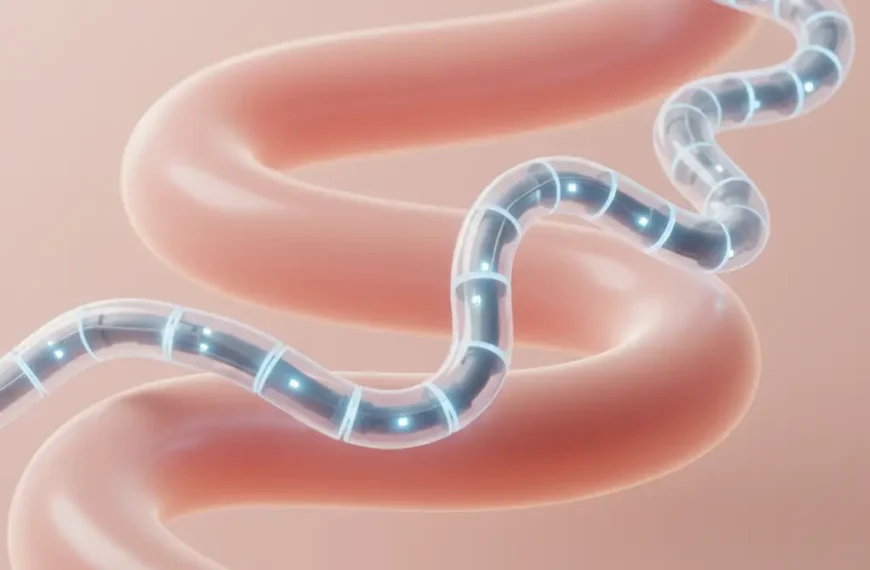
In surgery, a soft catheter could navigate the delicate, winding pathways of blood vessels while soft, minimizing the risk of damage. Once at the target location, it could stiffen slightly to provide the rigid stability necessary for performing a precise task, such as deploying a stent.
Human-Robot Collaboration (Cobots)
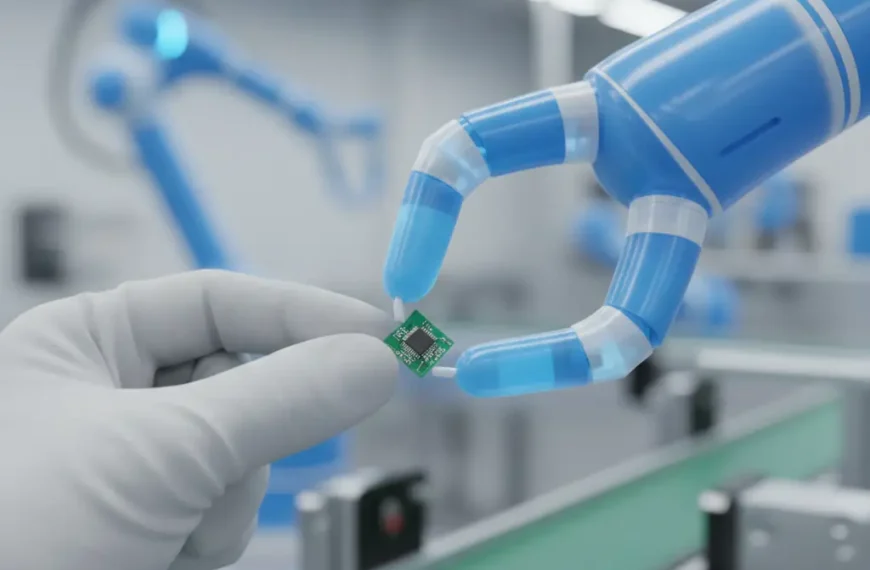
In manufacturing, a cobot could use a compliant, soft gripper to safely engage with a human co-worker. When ready to perform a task, the gripper could instantly stiffen to securely hold a heavy tool or a workpiece, ensuring no slippage or accidental dropping.
The safety is paramount here: the default state is soft, ensuring that accidental contact results in minimal force, but the performance state can be rigid for necessary tasks.
—
📝 Notes on Stiffening Performance
- Speed is Crucial: The time it takes for a soft robot to transition from fully compliant to fully rigid (or vice versa) is a critical performance metric. Jamming techniques typically offer the fastest transition times.
- Energy Consumption: Granular jamming requires continuous vacuum power to maintain the rigid state, whereas phase change materials require an initial energy burst (heating/cooling) to change state but can hold the state passively.
- System Integration: Controlling the stiffening mechanism must be seamlessly integrated with the robot’s main control and actuation (e.g., pneumatic networks).
—
💡 Tips for Understanding the Technology
Focusing on the Key Mechanisms
- The Trade-off: Recognize that programmable stiffness seeks to mitigate the trade-off between compliance (safety/adaptability) and rigidity (precision/force).
- The How: When reading about new designs, always identify the stiffening mechanism (e.g., vacuum, heat, magnetic fields).
- The Goal: The primary function is not just to be stiff, but to be able to actively control the stiffness profile across the entire robot body.
Programmable stiffness represents the next major leap in soft robotics, moving them from specialized demonstrators to truly versatile tools capable of tackling complex, high-reliability tasks in the real world.
 By
By