
🚁 Beyond the Propeller: Looking to Nature for Flight
Modern drones, or Unmanned Aerial Vehicles (UAVs), are predominantly built around fixed-wing or quadrotor designs. While effective, these rigid systems often struggle with energy efficiency, silent flight, and navigating complex, cluttered spaces.
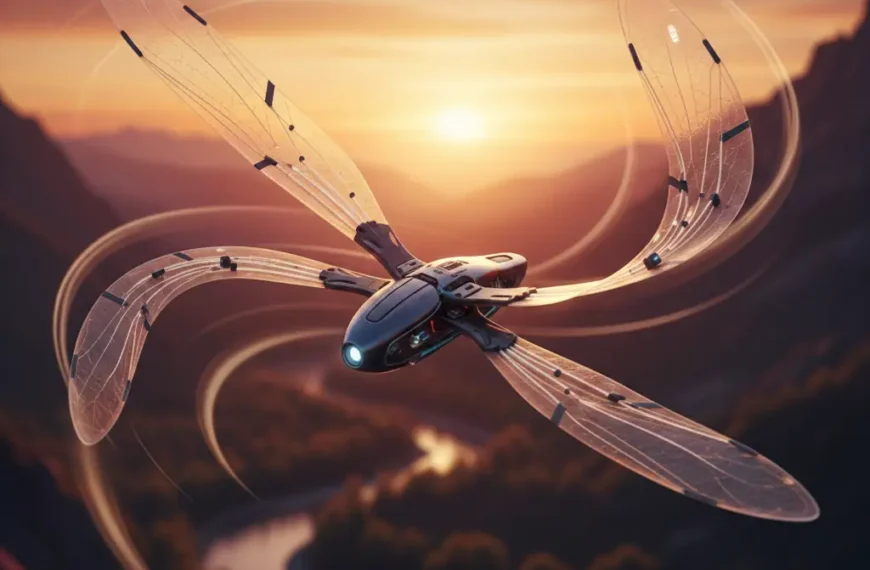
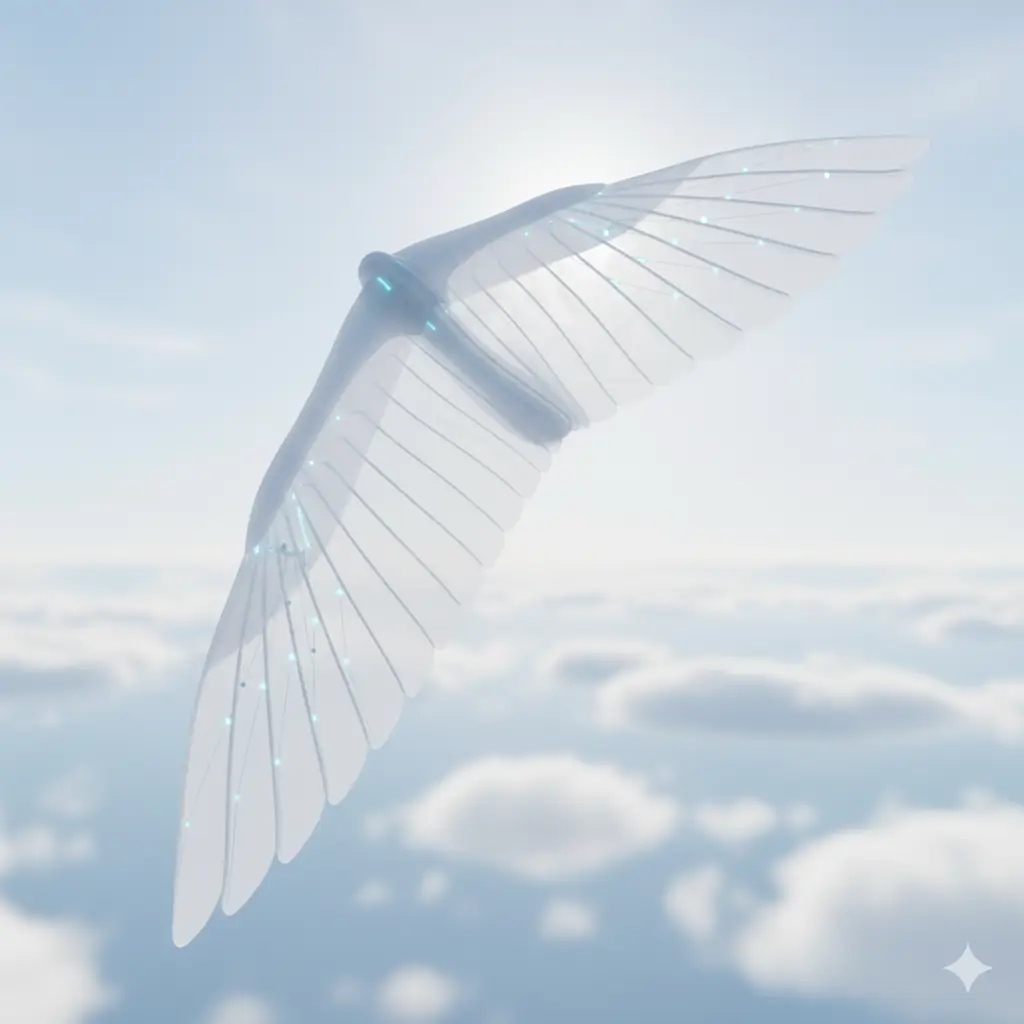
Nature, however, offers a masterclass in aerial agility. Birds and insects achieve extraordinary maneuverability, stability, and silent propulsion by utilizing flexible, dynamically deforming wings and feathers. This is where soft robotics steps in.
By studying biological flyers, engineers are using soft, compliant materials to create a new generation of aerial vehicles that can literally ‘fly with flaps,’ unlocking unparalleled agility and efficiency.
—
🕊️ The Science of Dynamic Deformation
The secret to a bird’s flight isn’t just the flapping motion, but the controlled deformation of its wings. A bird’s wings subtly change their shape, twist, and camber (curvature) during each flap to precisely control lift and thrust.
Traditional rigid drone propellers and wings cannot replicate this continuous, dynamic shaping. They rely on fixed mechanics, limiting their performance during high-speed maneuvers or when facing sudden gusts of wind.
Soft robotics allows us to incorporate this natural flexibility directly into the wing structure, enabling a form of flight that is intrinsically more stable and adaptable than rigid aviation.
Actuators as Artificial Muscles
To power these flexible wings, soft aerial vehicles often rely on non-traditional actuators that mimic biological muscle contractions, rather than conventional rotary motors. These may include:
- Dielectric Elastomers (DEs): These ‘artificial muscles’ contract or expand when voltage is applied, offering high power-to-weight ratios ideal for small, flapping wings.
- Shape Memory Alloys (SMAs): These metal alloys can be trained to ‘remember’ a certain shape and return to it when heated, providing a simple, repeatable flapping mechanism.
These actuators allow the wing structure to move and deform organically, generating complex, non-linear forces necessary for agile, bio-inspired flight.
—
🦋 Micro Aerial Vehicles (MAVs): Scaling Down Flight
The soft robotics approach is particularly impactful in the development of Micro Aerial Vehicles (MAVs)—drones the size of insects or small birds. At these small scales, air viscosity and drag become disproportionately large, making flapping flight superior to propeller-driven designs.
Engineers have successfully created robots that mimic the flight of flies and moths, using ultralight, flexible polymer wings. The elasticity of the soft materials allows the wing to store and release energy efficiently during the flapping cycle.
This resonant flapping dramatically improves energy efficiency, enabling these tiny robots to fly for longer periods on minimal battery power, a crucial breakthrough for miniaturized systems.
Flexible wings inherently increase stability. If a gust of wind hits a soft wing, the wing deforms, absorbing the energy and passively correcting the flight path. A rigid wing would require complex, high-speed electronic intervention to recover.
—
🔭 Applications: Silent Spies and Resilient Explorers
Soft aerial vehicles, with their unique flight characteristics, are opening up new opportunities that were previously inaccessible to rigid drones.
Silent Monitoring and Reconnaissance
Flapping wing robots are inherently much quieter than noisy propeller-driven quadcopters. This makes them ideal for covert surveillance, wildlife observation, or monitoring sensitive human activities without intrusion.
Navigating Cluttered Spaces
Their high agility and resilience to impact are perfect for navigation in cluttered urban environments or inside buildings. If a rigid drone collides with an object, it often crashes; a soft drone might simply bounce off and recover mid-flight due to its compliant structure.
Imagine a soft robotic bird flying through a forest canopy or a damaged warehouse, performing inspection or mapping tasks. Its resilience ensures mission completion where a rigid counterpart would fail.
—
🚧 Challenges on the Flight Path
Despite the promise, soft aerial robotics faces major hurdles before widespread adoption. Two key challenges are power density and high-level control.
Powering Flight
Flapping flight requires high instantaneous power. While soft actuators are lightweight, they need equally lightweight, energy-dense power sources (batteries or micro-fuel cells) that can also withstand the constant mechanical strain of flight.
Controlling Complexity
The continuous, dynamic deformation of soft wings is hard to model and control precisely. Engineers rely heavily on complex control algorithms and often Machine Learning to teach the robot how to utilize its flexibility for stable and agile maneuvering.
—
🛫 Roadmap for Soft Aerial Vehicles
The development of practical soft flying robots is following a clear trajectory focused on integration and autonomy.
- Advanced Composite Skins: Creating wing surfaces that are incredibly light yet highly durable and repairable (potentially self-healing).
- Integrated Actuator/Power Systems: Combining the soft actuators with flexible, onboard power sources to eliminate tethers and external components.
- Embodied Control: Designing the wing morphology to passively stabilize flight, simplifying the electronic control requirements.
- Autonomous Navigation: Equipping MAVs with micro-sensors and AI to make real-time decisions about flight path and wing adjustments based on wind conditions.
Soft robotics is truly changing the definition of aerial vehicles, moving us away from propeller-based designs and toward a future where our drones fly with the grace, efficiency, and resilience of nature’s best flyers.
 By
By