
Jellyfish-Inspired Propulsion: The Future of Efficient Aquatic Soft Robots
For decades, humanity’s exploration of the deep sea has relied on machines powered by propellers and thrusters. While effective, these methods are often energy-intensive, noisy, and can be quite disruptive to delicate marine ecosystems. There’s a growing need for a gentler, more efficient way to navigate the ocean’s depths.
Enter the jellyfish. These elegant, ancient creatures are masters of low-energy propulsion. Their simple, pulsing bell movement allows them to glide through the water with an efficiency that modern engineering is only now beginning to replicate. This approach, known as biomimicry, is leading to a revolution in aquatic robotics.
The Biological Blueprint: Why Jellyfish Are So Efficient
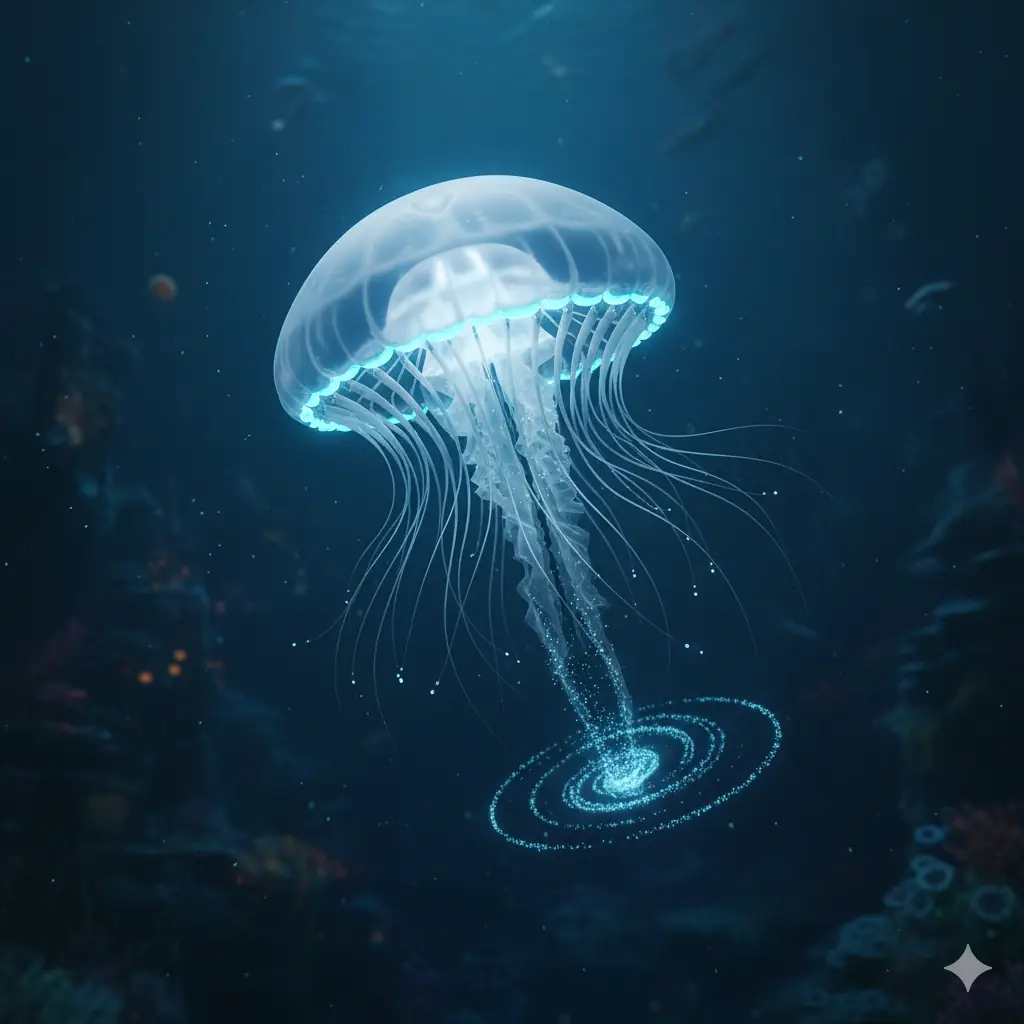
Jellyfish propulsion is a stunning example of fluid dynamics efficiency. They move by contracting their bell, which forces water out underneath. This generates a jet of fluid, propelling them forward—a classic example of Newton’s third law of motion.
However, the real genius lies in the physics of the wake they create. As the bell relaxes, it captures a ring of swirling water, a vortex, on the outside rim. This captured water actually gives them an extra ‘push’ or thrust during the expansion phase, a phenomenon known as ‘vortex-ring swimming.’
This method allows them to achieve very high ‘propulsive efficiency’—meaning they convert a large percentage of their energy into forward motion. It’s an inherently smooth, non-turbulent, and incredibly quiet way to travel, which is ideal for long-duration missions or stealth operations.
Key Features of Jellyfish Propulsion
The movement isn’t just a simple contraction; it’s a precisely timed sequence of shape changes. Their soft bodies are the engine, the transmission, and the propeller all rolled into one. This eliminates the need for complex, rigid mechanical systems that typically consume a lot of power and can easily break.
In essence, they are using their entire body to interact with the fluid environment, maximizing the surface area and minimizing energy loss due to friction and turbulence. This is a critical lesson for roboticists seeking to design machines that can stay underwater for weeks or months at a time without recharging.
From Biology to Soft Robotics
Translating the jellyfish’s biological mechanism into a functional robot requires a deep dive into soft robotics and advanced materials. Engineers are moving away from metal and wires toward flexible polymers, silicone, and hydrogels that can mimic the elasticity of biological tissue.
The resulting robots are typically constructed with a flexible, bell-shaped body and actuated using smart materials. One popular method involves using Dielectric Elastomer Actuators (DEAs) or Hydraulic Amplification (HASEL) actuators which can rapidly change shape when an electric field or internal pressure is applied.
Consider a micro-case example: one notable soft robot, called ‘RoboJelly,’ uses eight separate flaps driven by nickel-titanium wire actuators that contract when heated. This simple, distributed actuation system allows the robot to achieve continuous, undulating movement, closely mirroring the natural jellyfish pulse and achieving impressive energy efficiency.
The Challenge of Motion Control
While the concept is elegant, controlling a soft robot in a fluid environment presents significant engineering challenges. Traditional rigid robots are controlled by precise joint angles; soft robots, however, require controlling the complex, continuous deformation of their entire body.
Scientists use advanced modeling, often relying on Finite Element Analysis (FEA), to predict how the flexible body will deform in response to the internal forces and external water resistance. This allows them to create control algorithms that accurately sequence the actuation (the pulsing) to ensure predictable movement and direction.
Tips for Designing High-Efficiency Aquatic Soft Robots
- Prioritize Shape Dynamics: Focus on optimizing the bell’s geometry and material stiffness to maximize vortex-ring generation, as this provides the crucial secondary thrust.
- Minimize Internal Complexity: Use distributed actuation (like multiple small actuators) rather than a single large motor to reduce weight and centralize potential failure points.
- Choose Low-Hysteresis Materials: Select flexible materials that quickly return to their original shape after contraction. This minimizes wasted energy during the bell’s recovery phase.
- Integrate Bio-Inspired Sensors: Consider adding pressure or flow sensors on the robot’s surface to help it detect and react to subtle currents, much like a real jellyfish.
The Impact: Low-Energy Exploration and Ecology
The advantages of jellyfish-inspired soft robots extend far beyond mere engineering novelty. Their low-energy signature is a game-changer for long-duration ocean observation. A robot that can operate for weeks on a single battery charge can provide unprecedented data on deep-sea currents, climate change indicators, and marine life.
Furthermore, their soft construction and gentle propulsion make them ideal for interacting with sensitive ecosystems. Unlike noisy, fast-moving thrusters that can scare or injure marine animals, these soft robots can often blend seamlessly into the environment, offering scientists a less invasive way to study marine biology.
Here is a comparison of the Jellyfish-Inspired Soft Robot approach versus a Traditional Propeller-Driven ROV:
| Feature | Jellyfish-Inspired Soft Robot | Traditional Propeller ROV |
|---|---|---|
| Energy Efficiency | Very High (Leverages fluid dynamics) | Moderate (Energy lost to turbulence) |
| Noise Level | Extremely Low (Quiet operation) | High (Motor and propeller noise) |
| Interaction Safety | High (Soft, gentle movements) | Low (Hard materials, fast moving parts) |
| Speed | Low to Moderate | Moderate to High |
The next frontier in this field involves increasing the speed and maneuverability of these soft robots while maintaining their incredible efficiency. This often means exploring hybrid systems or more complex biological inspirations, such as the undulating fins of manta rays or the rhythmic clapping of scallops.
Ultimately, the jellyfish teaches us that sometimes the simplest, most natural solutions are the most effective. By learning from millions of years of biological optimization, we are creating aquatic robots that promise to explore the vast, unknown parts of our oceans with unprecedented stealth, safety, and efficiency.
 By
By